<?xml version="1.0" encoding="utf-8"?><feed xmlns="http://www.w3.org/2005/Atom" ><generator uri="https://jekyllrb.com/" version="3.10.0">Jekyll</generator><link href="https://neural3d.github.io/feed.xml" rel="self" type="application/atom+xml" /><link href="https://neural3d.github.io/" rel="alternate" type="text/html" /><updated>2025-09-04T10:06:54+00:00</updated><id>https://neural3d.github.io/feed.xml</id><title type="html">Neural3D</title><subtitle>Write an awesome description for your new site here. You can edit this line in _config.yml. It will appear in your document head meta (for Google search results) and in your feed.xml site description.</subtitle><author><name>First Lastname</name></author><entry><title type="html">In-person Meeting @ Chalmers</title><link href="https://neural3d.github.io/blog/meeting/" rel="alternate" type="text/html" title="In-person Meeting @ Chalmers" /><published>2025-09-04T04:00:01+00:00</published><updated>2025-09-04T04:00:01+00:00</updated><id>https://neural3d.github.io/blog/meeting</id><content type="html" xml:base="https://neural3d.github.io/blog/meeting/"><![CDATA[<p>We will meet together in Gothenburg at Chalmers and enjoy a full day of presentations the 4th of September, 2025.</p>

<p>The agenda is the following:</p>

<table>
  <tbody>
    <tr>
      <td>13.00</td>
      <td> </td>
      <td> </td>
      <td>Lunch</td>
    </tr>
    <tr>
      <td>14.00</td>
      <td>Josef Bengtson</td>
      <td>Chalmers</td>
      <td>3D Consistent Editing using Diffusion Models</td>
    </tr>
    <tr>
      <td>14.20</td>
      <td>Vahid Shahverdi</td>
      <td>KTH</td>
      <td>Neuroalgebraic Geometry: Geometry Under the Surface</td>
    </tr>
    <tr>
      <td>14.40</td>
      <td>Marcel Büsching</td>
      <td>KTH</td>
      <td>Tracking Deformable Linear Objects Using 3D Gaussian Splatting</td>
    </tr>
    <tr>
      <td>15.00</td>
      <td>David Nordström</td>
      <td>Chalmers</td>
      <td>Stronger ViTs with Octic Equivariance</td>
    </tr>
    <tr>
      <td>15.30</td>
      <td> </td>
      <td> </td>
      <td>FIKA</td>
    </tr>
    <tr>
      <td>16.00</td>
      <td>Christoffer Petersson</td>
      <td>Recohere AB</td>
      <td>(Tentative title) Neural Rendering for Autonomous Driving</td>
    </tr>
    <tr>
      <td>16.20</td>
      <td>Viktor Korotynskiy</td>
      <td>CTU in Prague</td>
      <td>Using monodromy to recover symmetries of polynomial systems</td>
    </tr>
    <tr>
      <td>16.40</td>
      <td>David Nilsson</td>
      <td>Chalmers</td>
      <td>Geometric consistency of image and video diffusion models</td>
    </tr>
    <tr>
      <td>17.00</td>
      <td>Kathlén Kohn</td>
      <td>KTH</td>
      <td>From barycentric coordinates in meshes to particle physics and back</td>
    </tr>
    <tr>
      <td>17.30</td>
      <td> </td>
      <td> </td>
      <td>Project discussions</td>
    </tr>
    <tr>
      <td>18.00</td>
      <td> </td>
      <td> </td>
      <td>End</td>
    </tr>
  </tbody>
</table>

<!--more-->]]></content><author><name>First Lastname</name></author><category term="Blog" /><category term="Meeting" /><category term="Chalmers" /><category term="Social Event" /><summary type="html"><![CDATA[We will meet together in Gothenburg at Chalmers and enjoy a full day of presentations the 4th of September, 2025. The agenda is the following: 13.00     Lunch 14.00 Josef Bengtson Chalmers 3D Consistent Editing using Diffusion Models 14.20 Vahid Shahverdi KTH Neuroalgebraic Geometry: Geometry Under the Surface 14.40 Marcel Büsching KTH Tracking Deformable Linear Objects Using 3D Gaussian Splatting 15.00 David Nordström Chalmers Stronger ViTs with Octic Equivariance 15.30     FIKA 16.00 Christoffer Petersson Recohere AB (Tentative title) Neural Rendering for Autonomous Driving 16.20 Viktor Korotynskiy CTU in Prague Using monodromy to recover symmetries of polynomial systems 16.40 David Nilsson Chalmers Geometric consistency of image and video diffusion models 17.00 Kathlén Kohn KTH From barycentric coordinates in meshes to particle physics and back 17.30     Project discussions 18.00     End]]></summary></entry><entry><title type="html">In-person Meeting @ KTH</title><link href="https://neural3d.github.io/blog/meeting/" rel="alternate" type="text/html" title="In-person Meeting @ KTH" /><published>2023-12-06T19:34:30+00:00</published><updated>2023-12-06T19:34:30+00:00</updated><id>https://neural3d.github.io/blog/meeting</id><content type="html" xml:base="https://neural3d.github.io/blog/meeting/"><![CDATA[<p>During the meeting in Stockholm, the project members discussed their ideas for future research projects, as well as gave an update on existing work.
Additionally, new project member Stefano Marigiliano gave an accessible introcution to the field of tropical geometry.</p>

<!--more-->]]></content><author><name>First Lastname</name></author><category term="Blog" /><category term="Meeting" /><category term="KTH" /><category term="Social Event" /><summary type="html"><![CDATA[During the meeting in Stockholm, the project members discussed their ideas for future research projects, as well as gave an update on existing work. Additionally, new project member Stefano Marigiliano gave an accessible introcution to the field of tropical geometry.]]></summary></entry><entry><title type="html">Second in-person Meeting @ Chalmers</title><link href="https://neural3d.github.io/blog/meeting/" rel="alternate" type="text/html" title="Second in-person Meeting @ Chalmers" /><published>2023-05-23T19:34:30+00:00</published><updated>2023-05-23T19:34:30+00:00</updated><id>https://neural3d.github.io/blog/meeting</id><content type="html" xml:base="https://neural3d.github.io/blog/meeting/"><![CDATA[<p>The second meeting in Gothenburg, was an opportunity for the project members to present their research in an internal poster session, and listen to exciting research presentations from Chalmers students.</p>

<!--more-->]]></content><author><name>First Lastname</name></author><category term="Blog" /><category term="Meeting" /><category term="Chalmers" /><category term="Social Event" /><summary type="html"><![CDATA[The second meeting in Gothenburg, was an opportunity for the project members to present their research in an internal poster session, and listen to exciting research presentations from Chalmers students.]]></summary></entry><entry><title type="html">Presentation on Generali[s,z]able Neural Rendering</title><link href="https://neural3d.github.io/blog/online-meeting/" rel="alternate" type="text/html" title="Presentation on Generali[s,z]able Neural Rendering" /><published>2023-04-24T13:00:00+00:00</published><updated>2023-04-24T13:00:00+00:00</updated><id>https://neural3d.github.io/blog/online-meeting</id><content type="html" xml:base="https://neural3d.github.io/blog/online-meeting/"><![CDATA[<p>The April project meeting, was focused on planning the in-person meeting in May. Additonally, PhD student Marcel Büsching from KTH gave a presentation on Generalisable Neural rendering.
<!--more-->
Generalisable Neural Rendering methods such IBRNet (Wang et al., CVPR 2023) and GNT (Varma T. et al., ICLR 2023) are not trained on a single scene as most current methods such as NeRF (Mildenhall et al., ECCV 2020), but rather across serveral different scenes.
These models therfore have a general understanding on how to aggregate information from source images and how to use this information to render novel views of the observed scene.</p>]]></content><author><name>First Lastname</name></author><category term="Blog" /><category term="Meeting" /><category term="Presentation" /><category term="KTH" /><summary type="html"><![CDATA[The April project meeting, was focused on planning the in-person meeting in May. Additonally, PhD student Marcel Büsching from KTH gave a presentation on Generalisable Neural rendering.]]></summary></entry><entry><title type="html">Presentation on Neural Rendering for Dynamic Scenes</title><link href="https://neural3d.github.io/blog/online-meeting/" rel="alternate" type="text/html" title="Presentation on Neural Rendering for Dynamic Scenes" /><published>2023-03-06T13:00:00+00:00</published><updated>2023-03-06T13:00:00+00:00</updated><id>https://neural3d.github.io/blog/online-meeting</id><content type="html" xml:base="https://neural3d.github.io/blog/online-meeting/"><![CDATA[<p>During the second meeting in 2023, the new team member David Nilsson introduced the team to the state of the art in neural rendering for dynamic scenes.
<!--more-->
Neural rendering for dynamic scenes has several aspects which make it more difficult than classic neural rendering for static scenes.
In particular, the fact that the observations of the scene are usually monocular (only one observation per time step) means that the observations of the scene become ambiguous, as there are multiple explanations for why a change has occurred in the scene.
For example, an object that appears smaller between two time steps may have either shrunk or simply moved away from the camera.</p>]]></content><author><name>First Lastname</name></author><category term="Blog" /><category term="Meeting" /><category term="Presentation" /><category term="Chalmers" /><summary type="html"><![CDATA[During the second meeting in 2023, the new team member David Nilsson introduced the team to the state of the art in neural rendering for dynamic scenes.]]></summary></entry><entry><title type="html">Welcoming David Nilsson and discussion on equivariant autoencoders</title><link href="https://neural3d.github.io/blog/online-meeting/" rel="alternate" type="text/html" title="Welcoming David Nilsson and discussion on equivariant autoencoders" /><published>2023-01-30T10:00:00+00:00</published><updated>2023-01-30T10:00:00+00:00</updated><id>https://neural3d.github.io/blog/online-meeting</id><content type="html" xml:base="https://neural3d.github.io/blog/online-meeting/"><![CDATA[<p>The Neural3D team started the new year by greating new team member David Nilsson who will be a postdoctoral researcher at Chalmers.
<!--more-->
The topic of the meeting was a discussion about the theoretical analysis of eqiuvariant autoencoders.
The discussion was led by KTH student Vahid Shahverdi, who first gave an introduction to algebraic geometry, how it relates to machine learning research, and how these methods can be used to analyse properties of equivariant autoencoders.
Additionally, the project members started planning the in-person meetings for 2023 and how to continue collaboration in joint research efforts.</p>]]></content><author><name>First Lastname</name></author><category term="Blog" /><category term="Meeting" /><category term="Presentation" /><category term="KTH" /><summary type="html"><![CDATA[The Neural3D team started the new year by greating new team member David Nilsson who will be a postdoctoral researcher at Chalmers.]]></summary></entry><entry><title type="html">Online Meeting and Discussion on InstantNGP</title><link href="https://neural3d.github.io/blog/online-meeting/" rel="alternate" type="text/html" title="Online Meeting and Discussion on InstantNGP" /><published>2022-12-08T13:00:00+00:00</published><updated>2022-12-08T13:00:00+00:00</updated><id>https://neural3d.github.io/blog/online-meeting</id><content type="html" xml:base="https://neural3d.github.io/blog/online-meeting/"><![CDATA[<p>The second online meeting of the project gave the participants an introduction into Coordinate Based Hybrid Representation.
<!--more-->
KTH student Marcel Büsching introduced the topic by giving a presentation on Instant Neural Graphic Primitives (Müller er al., ACM ToG 2022), a newly proposed method to drastically decrease the training time for Neural Radiance Fields (Mildenhall et al., ECCV 2020).
The general idea for these coordinate-based hybrid representations is to partition the learned information between a multilayer perceptron (MLP) and a spatial data structure, such as voxels or in the case of the paper discussed, a hash map.
This makes it possible to reduce the size of the MLP used and thus reduce the training time.</p>]]></content><author><name>First Lastname</name></author><category term="Blog" /><category term="Meeting" /><category term="Presentation" /><category term="KTH" /><summary type="html"><![CDATA[The second online meeting of the project gave the participants an introduction into Coordinate Based Hybrid Representation.]]></summary></entry><entry><title type="html">Online Meeting and Discussion on Equivariant Neural Network</title><link href="https://neural3d.github.io/blog/online-meeting/" rel="alternate" type="text/html" title="Online Meeting and Discussion on Equivariant Neural Network" /><published>2022-11-09T09:30:00+00:00</published><updated>2022-11-09T09:30:00+00:00</updated><id>https://neural3d.github.io/blog/online-meeting</id><content type="html" xml:base="https://neural3d.github.io/blog/online-meeting/"><![CDATA[<p>The first online meeting of the project was spent equally on organizational matters and scientific exchange.
<!--more-->
To introduce the discussion, Chalmers PhD student Josef Bengtson presented the paper Group Equivariant Convolutional Networks (Cohen and Welling, ICML 2016) and the current state of the art for Equivariant Neural Networks.
The ensuing in-depth discussion sparked several ideas which will be pursued in future research.</p>]]></content><author><name>First Lastname</name></author><category term="Blog" /><category term="Meeting" /><category term="Presentation" /><category term="Chalmers" /><summary type="html"><![CDATA[The first online meeting of the project was spent equally on organizational matters and scientific exchange.]]></summary></entry><entry><title type="html">First Meeting @KTH</title><link href="https://neural3d.github.io/blog/meeting/" rel="alternate" type="text/html" title="First Meeting @KTH" /><published>2022-10-10T19:34:30+00:00</published><updated>2022-10-10T19:34:30+00:00</updated><id>https://neural3d.github.io/blog/meeting</id><content type="html" xml:base="https://neural3d.github.io/blog/meeting/"><![CDATA[<p><img src="/assets/images/2022-10-10-group.jpeg" alt="image info" width="80%" /></p>

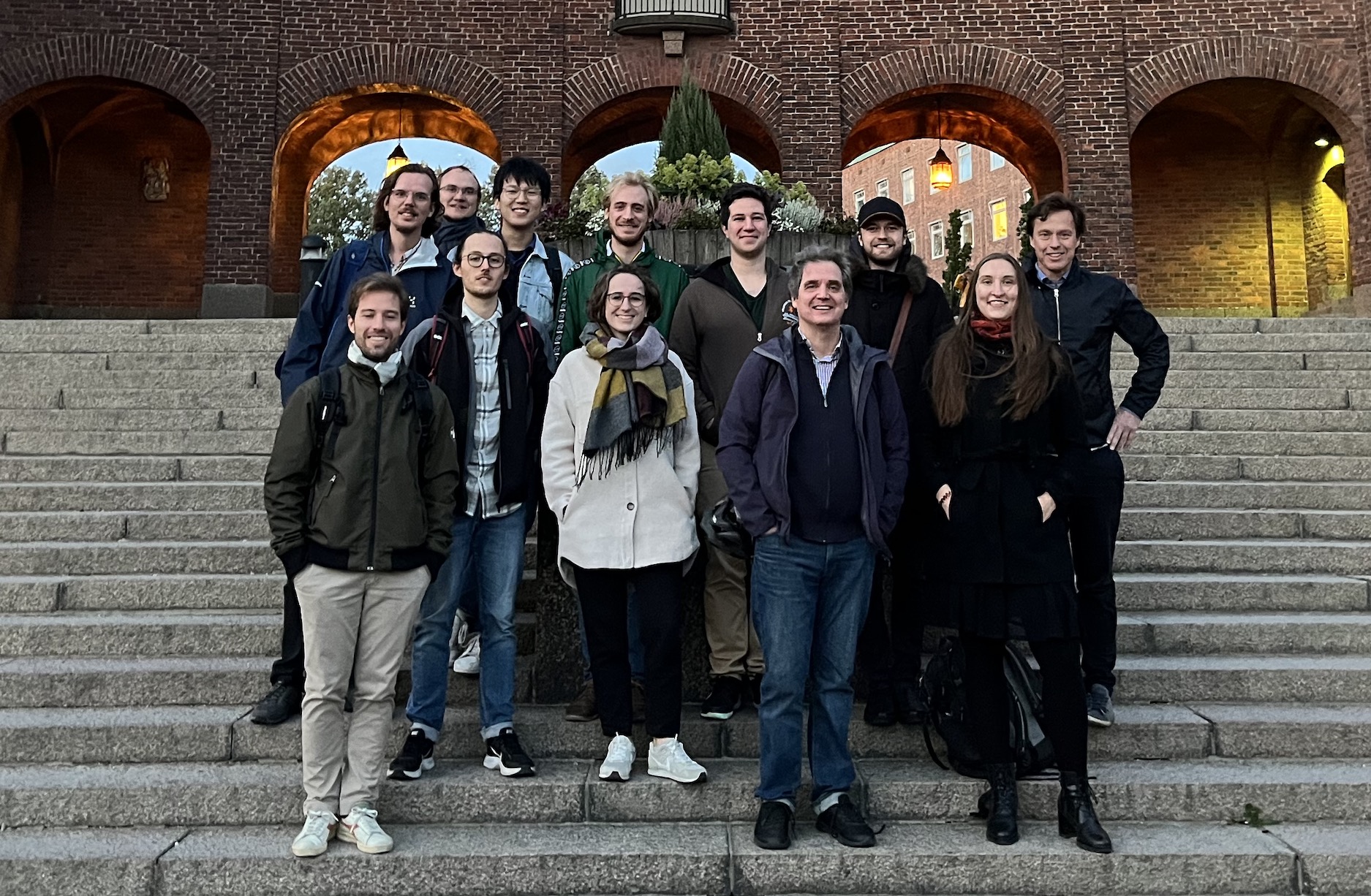
<p>The first meeting of the project, hosted by KTH, provided an opportunity for members of the KTH and Chalmers research groups to get to know each other, plan the further course of the project, and discuss expectations.
In addition to the official agenda, participants had ample opportunity to network in an informal setting over fika and dinner.</p>

<!--more-->]]></content><author><name>First Lastname</name></author><category term="Blog" /><category term="Meeting" /><category term="KTH" /><category term="Social Event" /><summary type="html"><![CDATA[The first meeting of the project, hosted by KTH, provided an opportunity for members of the KTH and Chalmers research groups to get to know each other, plan the further course of the project, and discuss expectations. In addition to the official agenda, participants had ample opportunity to network in an informal setting over fika and dinner.]]></summary></entry></feed>